John Christie Trumbull (Howard’s Father)
born 29 June, 1854
married 4 December 1889 to Harriet Mansfield (1866-1948)
died 5 March, 1927
Children: Howard, January 13, 1891; Freda, July 20, 1894; James, September 3, 1899
John Christie was named for his maternal grandfather Deacon John Christie of Magoon’s Point on Lake Memphramagog. He was born on June 29, 1854, in the log cabin by the creek on this Grandfather Trumbull’s farm a mile or so from Northwood. His brother Jimmy was three years of age. Jimmy died three years later at his grandparent’s home in Canada leaving John to become the elder brother to the siblings arriving in succeeding years.
John continued to live in the cabin for the next seven years and one can imagine a rather heavy responsibility rested upon his young shoulders as he watched over the young brother and sister who were also born a few years later in the log cabin. Young children had to help in those days. John, a quiet lad, would have the task of keeping the household well supplied with the water which flowed from the spring at the foot of the hill where the cabin was located. One can imagine him aiding his mother in filling the big black kettle that hung over an outdoor fire, in preparation for the family wash. There would be sticks of wood to carry from the woodpile where the trunks and limbs of trees had been cut into proper lengths. In fact, there was no limit to the jobs a small boy could perform to assist his mother.
John was a favorite companion of his grandfather James and worked at his side as they planted the crops in the fields or worked in the garden. Grandfather James took this opportunity to share his Christian faith with John who received no such training from his father. His mother Catherine, reared in a devout home, must have had a Christian influence in her children also.
John was seven years of age where the transition was made from the cabin to the commodious new house some distance from the creek. He was glad to have a solid roof over his head, and no cracks in the walls to permit the snow to blow across the floor or sift down the coverlet as it had done in the loft of the cabin where his bed had been located. The new house was a much more comfortable home for the growing boy.
John must have joined the neighbor boys in attending the school located on the Johnson farm. He quickly learned the multiplication tables as well as the tables of weight and measure, and his teachers were pleased at the progress he made from year to year.
When he had absorbed all the neighborhood school could give, he entered Geneva College in the Class of 1872. He had taught one term of school before Geneva, probably to earn the money for his college fees. The only subject he talked later about was Latin and his reason for mentioning it seemed to be the amusement he received from listening to the pronunciation of the Latin words by a fellow student, a Negro named Pepper. John always treated the Negroes he knew with respect and kindness.
John taught school in neighboring communities for four years and had the reputation of being an excellent teacher as well as a very strict one. One school was in Hardin County, seven miles from the farm. He made the trip on foot each Monday morning and Friday evening, staying at night during the school week with some family in the neighborhood. He was an avid reader and enjoyed the humor in Dickens’ stories. He had an excellent vocabulary to which he kept adding as the years went by and his English usage was very good, a rather unusual achievement for a person growing up in a pioneer family.
John wanted to try some other type of work and became interested in Kansas where some of the neighbor boys had already located. There is no record of the work that he did in Kansas or how long he remained. His father soon sent for him to come home as he needed his help on the farm.
Robert had never paid his father for the farm and some time before his death Grandfather James had told John, “If you stay on the farm and look after the needs of your father and mother, the farm is to be yours as a gift from me”. The old gentleman had evidently made it clear to Robert, as well, that he was bequeathing the farm to John. However, the transfer, or the terms, were never put into a written form that would have been legally binding.
John had always been a favorite child as far as his mother Catherine was concerned and when she died in 1888, John knew it was time to plan for a home of his own. At the community parties he had attended he was attracted to a young lady with black hair and gray eyes, a school teacher, as he had been, and the daughter of a plucky widow who had taught school in the community to provide for her family of five children after the sudden death of her husband.
On December 4, 1889, Harriet Jane Mansfield became the bride of John Trumbull who took her to the small frame house he had erected south of the original house in which his father and sister Anna lived. A large garden and orchard separated the two houses.
Life on a farm is never easy. Work horses had taken the place of the slow moving yokes of oxen but the farmer walked behind the plow in a narrow space the plow had cleared and when the plough-share struck a stone or root of a tree, his body felt the impact. A farmer went to the house weary at the end of the day and would still have the evening chores to do.
John found a real treasure in Harriet as a farmer’s wife. At home she had always preferred to work with her brothers in the field rather than with her sisters in the house. She had learned to milk the cows, drive the team, care for the chickens, make the garden, do the chores at the barn such as feeding the horses and cows, and filling their mangers with hay. She was happy to help with some of the outside work.
Within the ten years following their marriage, three children were born – Howard on January 13, 1891; Freda on July 20, 1894, and James on September 3, 1899. The small house was full and really crowded but there was always time and room to entertain friends and relatives. In spite of crowded conditions it was a hospitable home and even unexpected guests were welcome.
Harriet had adapted to housework very well and had become an excellent cook and bread-maker. Her “chess” pie was a gourmet’s delight and the recipe in demand. Most of the food was raised on the farm and the flour and cornmeal were made in Belle Center from the grain grown on the farm.
Actual money was scarce and was usually obtained when a steer was sold to the owners of the Belle Center slaughterhouse or eggs and butter were taken to the grocery store and purchased by its owner. A strict account was kept and the money tithed to provide a gift for the collection plate passed at the Sunday services in the Northwood United Presbyterian Church which the family attended faithfully.
None of the children were sent to school until the seventh year of age had been reached and all could read before they entered school. With both parents being former school teachers, each child had to produce reasonably good grades and the parents conducted many spelling and arithmetic lessons when the teachers made extra assignments.
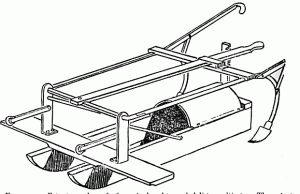
corn sled
John had more help when his elder son Howard was old enough to assist with the evening chores. Then there was the extra hand as the boys rode the horse pulling the corn cutter sled to cut off the corn stalks which were caught as the sled passed down a central path with its huge blades slashing off a row of stalks on each side. Two men rode the sled and when each had gathered an armful of stalks, the sled was stopped and the corn stalks tied, stood on end, and placed against each other to form, when other bundles had been added, a tepee-like shock that would shed the rain and help the corn ears to dry and harden for the husking process. Before the advent of the corn sled, the corn had to be cut by hand with a long blade joined to a handle, called a corn knife. Cutting with the corn sled, which had huge sharp blades on each side, was a much faster process but it also required dexterity as the men grabbed the stalk and formed the bundles as they stood on the moving sled.
What was sowed was with the farmer walking behind the drill and guiding his horses in straight lines across the field. Walking over the well cultivated soil was tiresome and a field of eight or ten acres added up to miles of walking.
John set out fruit trees, gooseberry and currant bushes, and took care of the apple trees from the original orchard set out by his father when the farm house had been built. He had a wonderful crop of various types of plums for several years before some type of disease killed the trees. An old Bartlet pear tree bore bushels of fruit year after year and there was usually some type of fruit to pack in the children’s lunch pails. There was no end to the work to be done in order to provide food for the family and for horses, cows, beef cattle, and chickens. There was no vacation for this man, but the Sabbath was a day of rest, not only at the Trumbull farm but throughout the community.
The family attended the Sunday School and church services held in the United Presbyterian Church at Northwood. A part of the chores on Sabbath morning was getting the horse and buggy ready for the mile-plus trip to church. As the children grew in size, a two-seated carriage was purchased with curtains to keep out the rain or snow. Money had to be saved for these expenditures as going into debt was not an acceptable practice.
The children walked to school, going through fields, climbing over fences, and crossing a creek in order to reach the Beechwood schoolhouse. When they transferred to the Northwood School, they either unlatched a large gate or climbed over it to be able to walk on a graveled road the rest of the way. The distance was somewhat longer but the travelling was easier. Raincoats and umbrellas were unknown luxuries but if a severe rain or snowstorm occurred at the time school closed, John was waiting with the horse and buggy to take the children home – an extra chore added to a busy day.
Although John had never had the privilege of attending high school, such schools had been organized by the time his children had outgrown the country school system. To make sure that the pupils were ready to enter high school if they desired to further their education, state officials had divided an examination called the “Boxwell Exam” which was administered in the county seat by a committee chosen for that purpose. The grades were sent out by mail. All the Trumbull children passed the examination on their first try and John and Harriet, feeling compensated for the sacrifices they had made attended the local graduation exercises with pride.
Attending high school cost money. If a pupil could not walk to school because of the distance, transportation had to be furnished; all school supplies had to be purchased, even the clothing had to be a little better; for it was a select group who attended high school in those days when there were no compulsory attendance laws.
High School began in September and closed the last of May or whenever nine full months had been completed. That meant that John bore all the burden of the work on the farm during the week except for Saturday when Howard could give his time to whatever work was at hand. The corn was husked in the field, covered over with the fodder, and left until enough had been collected for a wagonload; then it was loaded into the wagon and hauled to the corn storage shed near the horse barn. If some of the corn had been left standing, it was husked and thrown into the wagon drawn up beside the corn rows. The farmers worked against time to get the corn husked and under cover before the first snowfall. They didn’t always succeed and then entire shocks would be hauled to the barn and husked under cover but in penetrating cold.
With night study a regular occurrence, better light had to be provided and the old coal oil lamp was replaced by a new model in which air was mixed with the oil and a different type of wick made a much brighter light. The glass globe was also covered by a shade which directed the light downward on the book or paper placed near the lamp.
As soon as the supper dishes were cleaned from the table the “study light” was put in place, school books were opened, and study began, often lasting until a parent announced “It’s nine o’clock and time to get your rest.”
John kept the two stoves in the small house well supplied with wood and arose early to have a brisk fire burning. Breakfast was served early, followed by John’s reading a portion of Scripture and leading the family in prayer. School lunches were packed, the horse was attached to the buggy, and the two older children were off to school. Howard drove to high school for three years. The fourth year of high school was added two years later when his sister Freda graduated, a part of each of her last three years in high school was spent in the home of her grandmother Catherine whose house was located close to the school building.
Fortunately for the parents there were few extracurricular expenses, but the barn rent in town had to be paid regularly each month, the horse shod at intervals, and the buggy kept in good repair. The parents were denied any transportation during the week but the children willingly did all the necessary errands in town: buying groceries; taking grain to the mill; and depositing checks at the bank. Nevertheless, the part of the year when school was in session demanded much sacrifice on the part of both parents.
The same horse served all three of us in taking us to school and faithfully delivered us at our destinations both going and coming. He was put in a stable one block from the school grounds and we had to feed him at noon. He didn’t get any water during the day but no doubt made up that deficiency when he returned to the farm at night. Jim was the one who had a talking relationship with Dan and the horse seemed to understand. Once when Jim was standing by the gate which he had opened for Dan and the buggy to pass through, Jim said something like this, “Dan, you old rascal, get a move on” and as the horse started through the gate Jim made as though to kick him in the ribs. Dan stopped for a moment and kicked back. Jim burst into laughter and closed the gate and climbed into the buggy, still chuckling. No doubt, Dan was laughing, too. He was a faithful, patient old horse and served the entire family well.
It was evident that if the Trumbull children were to have a college education they would have to work for it themselves. John had to share all that was raised on the farm with his father. Grandfather Robert Trumbull did help with the husking of the corn and he used his scythe to cut the weeds that grew in the barn lot. He helped to haul the wood from the places where dead trees had been cut down and sawed into lengths which could be more easily split with an axe. He also drove the horse that was hitched to the heavy ropes which drew the large forkfuls of hay into the barn loft. The heavier work of plowing, cultivating, and harvesting, was John’s responsibility.
It was easier for a boy to find jobs in those days and Howard finally accumulated enough money to enter Muskingum College. By working during the summer, he managed to graduate in 1914. Freda taught school for a couple of years and saved her money and graduated in 1919. Jim graduated from school at the head of his class in 1917, just a few days before Grandfather Robert Trumbull’s sudden death which precipitated a number of changes.
In his will Grandfather Robert specified that the farm was to be sold and the proceeds divided amongst his children. There was no mention of his father’s desire that the farm be turned over to John and he did not contest the will. The farm was appraised and John purchased it, going into debt to do so. At age sixty-three, signing the mortgage for several thousand dollars must have taken a lot of courage. The only help he would have now was from the lad who had just graduated from high school and had his eye on a college diploma.
James had visions of expanding the operations on the farm with programs that would provide more cash. Other farmers in the neighborhood had already invested in tractors, as well as automobiles. The purchase of a Fordson tractor was made through another loan and more land was put under cultivation. The work horses were kept and John used them for cultivating and planting while Jim was using the tractor for other jobs.
Aunt Annie moved from the house that had been her house for more than a half century. She rented an apartment in Belle Center until a house could be built on her ten acres of ground that had been a part of the farm. A neighbor who was a carpenter agreed to build the house and in due time the construction began.
Meanwhile John and Harriet moved into the big house where there was room for everyone to have his own private quarters.
John’s family had continued in the Northwood Church, but its members had been leaving to join the much larger church of the same denomination in Belle Center. The Northwood congregation had shared its pastor with the small congregation in Huntsville and the arrangement was difficult for both pastor and people. Finally, the few remaining members in the Northwood Church voted to close the church and transfer their membership to other churches. John and his family transferred their membership to the Belle Center congregation where they were warmly welcomed. John’s knowledge of the Bible was soon manifested in the Sunday School class he had joined and it was not long until he was elected to positions of responsibility and trust. He was assigned as teacher of a class of young married women, elected to the position of elder, and, in time, represented the church as a delegate to the General Assembly, the highest official body of the church, when it met in Boston in May, 1917. He had always conducted morning and evening worship at home with his family as his grandfather and great grandfather had done. His own father Robert had not adopted that precedent. It took courage for John to take the stand for Christianity that his grandfather had taken. Harriet’s family were staunch Christians and John felt at home with all of the members.
One of the first renovations on the farm after the death of John’s father Robert, was the tearing down of the cattle sheds projecting east from both ends of the large hay barn, and raising of the building approximately ____ feet and enclosing that pact of the barn for a ground floor which was subdivided into a driveway, stanchions for milk cows, and pens for calves and feeding cattle. A large shed was erected on the last side of the barn to be used to shelter the cattle in the late fall and winter months and give them enough room to move about freely. This renovation and rebuilding was a mammoth task but it was accomplished by family members. A new lane was laid out connecting the farm buildings more directly with the township road that bordered the acreage on the east. A bridge had to be erected for the lane to cross the run and many tons of dirt and crushed stone filled in at either end of the bridge to eliminate the hollow on either side.
It was not long after the completion of the work on the barn that John complained of not feeling well. During the spring while spraying the orchard trees with lime-sulphur, some of the liquid had fallen into his boots and eaten away the skin, causing open sores. The sores did not respond to the household treatment usually effective for minor cuts and bruises, and John contacted a Belle Center physician whose rather extensive examination revealed that John was a victim of diabetes which was one reason the sores did not heal readily. John’s medication for the disease was given by mouth as insulin injection by the patient was not used at that time. He was also assigned a rather strict diet. The family menu had always been built on vegetables, meat, eggs, and fruit, with cakes, cookies and pies reserved for company or special occasions.
The farm work became more and more Jim’s responsibility and he was able to attend only the winter and spring quarters at Ohio State University. By coming home on Friday nights, he could usually complete the jobs he had been unable to finish before his classes convened.
While John could do no heavy farm work, he could still do some chores, husk a little corn and haul it to the crib with old Dolly and the one-horse sled. He was asked to be one of the Logan County Land Appraisers in the early 1920s along with Mr. Lafayette Fisher of Belle Center.
The horse “Old Dan” was no longer available and had not been replaced. Good driving horses were scarce. Anyway, the old buggy would have to be replaced. Most people were turning to automobiles; so, Freda used her savings and purchased a five-passenger Chevrolet. It was an open car with side curtains that could be snapped in place in case of rain. It also had a hand crank to serve as a starter for the engine. The Chevrolet Agency in Belle Center was owned by Oliphant and Workman, and Workman was Uncle Sam, the husband of John’s youngest sister Janet. Sam gave the new owner a lesson on setting the carburetor, putting the engine out of gear before using the crank in front of the engine. It one was fortunate, the engine responded on the first turn of the crank and one rushed back to adjust the carburetor to a more moderate flow of gas.
The car was used to transport John daily to his rendezvous with Mr. Fisher and Mr. Fisher delivered John to his own gate at the close of their work day. After John had paid his share of the transportation, there couldn’t have been much left of his wages, but he had the satisfaction of rendering a public service, of meeting new people, and being aware that he was still useful.
Having a car made it much easier for John and Harriet when Freda left for her job in a school in the next county and James resumed his work at OSU. Harriet was a self-taught driver taking the car into the wide open spaces of the pasture. She learned to shift the gears, put on the brake, and back the car in a straight line, a process needed to remove it from its shelter in the shed which once housed the buggy. John never learned to drive the car, nor ever expressed a desire to do so, but unlike his father, he expressed no uneasiness about riding in it.
In the Summer of 1926, a good share of the corn and grain was raised in the acreage lying north of the creek. One day in late August, Jim was working in one of those fields and his father John was interested in discovering just what Jim was doing. He managed to go up the steep narrow stairs leading to the upper hall of the farmhouse. John crossed the floor of the north bedroom in which one of the windows looked out over the roof of the large kitchen. John opened the window and managed to crawl out on the roof where he sat for some time, gazing around at different parts of the farm and watching Jim and whatever he was driving: the team or the tractor, moving back and forth across the field. He decided to come downstairs again and reversed his rather perilous trip in safety. Then he thought he might have a clearer view if he walked down the lane leading to the creek, or he might even have had it in mind to cross the creek and follow the wagon tracks to the field where Jim was working. However, John appeared to grow weary before he had traversed little more than half the distance to the creek and so turned around to make his way back the slight incline of the lane that would bring him to the safe shelter of the house. His progress was slow and anyone noticing him could see that he was dragging one foot a little. However he made no complaint and the evening was spent uneventfully. The next morning when he didn’t appear at the usual time, an investigation showed that he was paralyzed on one side.
Fortunately, Jim had graduated from OSU the year before and would be at home to help care for his father. Freda was under contract for her fourth consecutive year in the Waynesfield High School. Harriet, at sixty years of age, was still strong and active and felt she could cope with this tragic situation.
John’s bed was moved into the large front living room where he could look out the large bay windows and watch the activity in the garden or in the barnyards where the tractor or the team or any of the farm implements might be involved.
John was a good patient and never complained of this tragedy that had befallen him. Friends, neighbors, and relatives came to see him and his young pastor made frequent visits. If the days were long, the nights were probably much longer as there was no activity to break the monotony. Six months passed by and during the early morning hours of the fifth of March, his soul left his weary frail body and John went to be with his Lord whom he had faithfully served.
Brother George with his wife Kate came from Dallas and son Howard from Greensville, Tennessee. The funeral was held in the United Presbyterian Church in Belle Center with his pastor, Reverend R. S. Elder leading the service. Burial followed in the Mansfield lot in the Northwood Cemetery not far from the graves of his father and mother. A number of years later, the body was transferred to a lot in the Belle Center Cemetery at the request of Harriet who had decided in the intervening years that her body should be buried in the cemetery where the bodies of other family members were lying.
Because of John’s failing health, the remodeling of the ancient farm house had been postponed from year to year but in 1927, after the crops had been planted, the work on the house began. The bay window was removed entirely. All the partitions in the house were removed as was the staircase. The work was done by members of the family, but principally by James and his mother Harriet. Both could wield the wrecking bar. The kitchen at the north end of the house was removed entirely, the fireplace and chimney were removed brick by brick. A large one story room was built on the back of the house and a new chimney was built extending from the basement which had been enlarged to the height of what would be the new roof when the house was completed. This large room would serve as living room and kitchen while the rest of the house was in the process of building. It had a heating stove in it and an oil stove with three burners served as a cook stove. Comfort was sacrificed and the work progressed rather slowly, to be sure, but in three years the work was completed.
Since no electric power lines had been erected in the community, a Westinghouse electric plant was installed in the basement. Jim had put in heavy wiring in all of the rooms and an electric pump was installed in the basement to pump water from a large cistern into the kitchen, laundry room, and bathroom. When the REA was provided several years later no changes had to be made to hook onto the power lines.
Harriet lived to see her five grandchildren grow into adulthood, graduate from high school, and attend college. Three of them, Harold, Eleanor, and Eugene, joined the armed services when President Roosevelt provoked the Japanese into attacking Pearl Harbor and the country was drawn into a war which was waged by the U.S. on two fronts. Fortunately, the young Trumbull participants were not war casualties and returned to college to complete their education after the war was over.
Harriet was also able to attend the wedding of the eldest granddaughter Eleanor and a year later to hold in her arms the first great grandchild Denny. She was invited in 1947 to the wedding of the oldest grandson Harold but did not feel equal to the long ride to and from Columbus where the ceremony was held. Harriet’s health diminished during the summer and fall though she never missed any of the worship services in her church until late in December, 1947. She was hospitalized and spent Christmas in the hospital but was released to come home a week or so later. She had lost all desire to live and gradually grew worse until her death which occurred on April 30, 1948. Funeral services were conducted in the United Presbyterian Church by her pastor, Reverend Peter Pascoe, and burial followed in Fairview Cemetery.