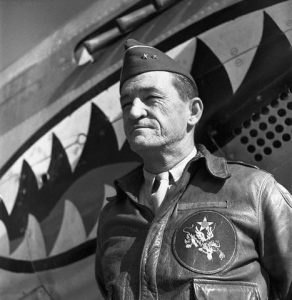
Major General Claire Chennault, 11/15/1944 Commander in the US Air Force, Kungming, China

Chiang Kai-Shek

The “Flying Tigers” started out as an All Volunteer Group (AVG) under a secret executive order from President Roosevelt on April 1, 1941. Claire L. Chennault, a retired Army Air Corps captain, accepted the task of reorganizing China leader Chiang-Kai-Shek’s Air Force. China had been in war with Japan since 1937 and begged the U.S. for help and airplanes. The AVG started out as 100 pilots and 200 ground crew members recruited among active duty personnel “The aircraft noses were painted to symbolize the grinning mouth, flashing teeth, and evil eye of the tiger shark,” (military.com) thus the tagline “Flying Tigers” caught on around the world. Their mission was “to protect the rail-, road- and sea-based supply routes between China and Burma.” (E.R. Johnson) “The AVG was credited with the destruction of 286 Japanese aircraft”, and “had only eight pilots killed in action.” (military.com)
The U.S. Army Air Forces arrived in July 1942, so the AVG disbanded and became the China Air Task Force (CATF). Chennault continued as the commander and was promoted to Major General.
Using tactics developed by Chennault, they shot down 297 Japanese aircraft, plus 153 probables, in only seven months of combat, from December 1941 to July 1942. They lost only four pilots and 12 Tomahawks in combat. ‘For a time, the Flying Tigers provided the only victories against the Japanese anywhere in the Far East,’ Duane Schultz, author of The Maverick War, wrote. ‘This handful of men had shown that the Japanese were not invincible.’” (William B. Allman, Aviation History)
On March 5, 1943, the Fourteenth Air Force was created from the CATF. Its headquarters were in Kunming.
Their military objectives were to:
(1) defend the Allied supply lines over the Himalayas;
(2) seek and destroy enemy aircraft and troop concentrations;
(3) destroy enemy military and naval installations;
(4) interdict and destroy enemy shipping along China’s coastline and inland waterways;
(5) interdict and destroy enemy supply lines within China, Indochina, Thailand, Burma and Formosa;
(6) provide close air support to Chinese ground forces; and
(7) encourage the Chinese resistance to assist AAF airmen in enemy-occupied territories.In short, they were to stall Japanese forces as long as possible, not defeat them. It would ultimately be the job of Chiang Kai-shek’s armies to repel the Japanese, but in early 1943 Chiang’s poorly trained and ill-equipped forces could scarcely defend the territory they already held. (E. R. Johnson, Aviation History)
In May, Harold arrived Suichuan, China, a 2-month old airfield, put up in a tea field, which was at the end of the longest supply line from the United States in all of the world and was close to Japanese territory.

During World War II, the China-based Fourteenth Air Force was not only the most short-lived of the numbered air forces, existing for a period of less than 34 months (March 5, 1943 to December 31, 1945), it was the smallest to operate in a combat theater, reaching a peak strength of just six air groups and four auxiliary squadrons (approximately 700 airplanes) by the end of 1944. It holds the singular distinction of being the only numbered air force to have been wholly created, organized and operated within a war zone. Despite its limitations, the Fourteenth went on to produce a truly astounding war record: 2,908 enemy aircraft destroyed or damaged against 193 combat-related losses of its own; 2.1 million tons of shipping sunk or damaged; 99 warships sunk or destroyed; an estimated 18,000 small rivercraft (carrying enemy troops and supplies) destroyed; and 1,225 locomotives, 817 bridges and 4,836 trucks destroyed. Added to that were approximately 59,500 Japanese troops killed in close air support engagements. (E.R. Johnson, Aviation History)

General Joseph Stillwell
After a month, the Japanese swept through all the airfields of the Sichuan Valley. The U.S. left and went to Cheng Kong, south of Kungming, where they maintained operations for the rest of the war. Both Kunming and Cheng Kong were Air Transport Command (ATC) bases. Their orders were to support General Joseph Stilwell‘s campaign down the Salween River in Burma.
At Cheung Kong there were P-40 and P-51 airplanes. There was only one squadron of P-38s in China. P-38s have a turbocharger that allowed the aircraft to go to 37,000 feet and used for long range special missions. P-38s were rugged aircrafts that could carry two 1000 pound bombs with a range over 2000 miles if external tanks were attached.
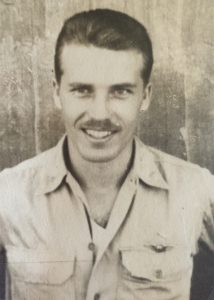
Harold Trumbull
An interesting story Harold told about one of his missions:
“Vietnam was the most productive, I think, missions. The longest mission I ever went on was to bomb an airfield just above Dinang [French Indochina, now Vietnam], which was called Hue. And it’s one way down here; that’s about 1100 miles. So that means we’d have start off with two-165 gallon drop tanks, fly down behind the hills, very low, so the Japs wouldn’t know we were coming, and then when we got down here we would jump across the mountain and head for the airfield at full throttle. One of the fellows had to drop one of his tanks before he got there so he was told to go home because if he had run out of fuel in one tank by that time, there was no point in going on. So there were four of us, still able to go on. We came over the mountain, eased our throttles forward and picked up speed, and at the last moment we could hear radar in our earphones, so they were picking us up. But we figured they didn’t know if it wasn’t one of their own returning from Thailand. They had airfields in Thailand so that’s why we did it that way. We dropped our tanks where we figured at the last moment we could, because at almost full-throttle, with two engines, you’re gulping 200 gals/hour. You only have 410 or so internal gallons in your tanks. We spent 45 minutes over that airfield. Not a plane got off. We took them by complete surprise. We burned every plane lined up. We’d go into a roundabout, shooting into the hangars, figuring if there were planes inside, we would start fires inside, we did, we saw smoke. Well after 45 minutes we figured we did all we could and we were out of ammunition. We headed out to the South China Sea, we didn’t want to go near any airfields, then we set a course for home. We’d throttle back to 1600 rpm, a low manifold pressure ,where you could go both engines at about 50 gallons/hour. You really lean back, and you’re mushing along at about 200 mph. There’s a lot of haze in southern China and Vietnam. We wanted to miss Hanoi. We headed up in here. Mengteze [auxiliary base] was too cloudy to try to get in. We kept going and going and I saw the gas gauge going way down and I called up the flight leader and said that according to my dead reckoning, I think we’re overshooting. I’m going to set a course to where I think Kunming is. So I turned almost 90 degrees, and everyone else turned and followed me. They had their doubts too. When we landed, the mechanic told me I only had 15 minutes of gas left. So that’s about as close as I ever came. However, I’ve flown over Hanoi, and picked up my only bullet, I don’t know what it was from, but it went into the self-sealing wing tank, and I used to carry it around as a souvenir. I’ve lost it.” (Trumbull, 1998)